3 minutes. One site. One atmosphere.
This project investigates street photography as a practice of trace rather than capture. Each photograph emerges from a fixed three-minute presence at a single site. The duration is strict. The position is fixed. Movement belongs to the street, not to the photographer.
The project operates through an inversion of classical street photography logic. The photographer does not hunt moments or compose scenes. Instead, the photographer becomes the stable element through which the street passes. Bodies, gestures, and events act as temporal forces that leave marks on the photographic surface. The image is not a representation of what happened. It is an index of having been there.
Each session begins with a deliberate act of exposure. The photographer enters a location and accepts it as a coordinate in space and time. No repositioning follows. The camera is configured minimally and committed to. This commitment establishes the camera as a trace device rather than an expressive instrument.
During the recording phase, photographs are made without pursuit or anticipation. Subjects are not isolated. Partial figures, overlaps, occlusions, and missed alignments are not corrected. They are essential. What matters is not the decisive moment but the accumulation of temporal interference between a static body and a moving environment.
The final image of each session marks cessation rather than climax. It functions as a terminal trace. A residue of presence. A proof that time has elapsed.
Review and interpretation are postponed. Images are not evaluated on location. Meaning is constructed later, outside the street, separated from the lived moment. What remains is not a narrative but a fragment of duration.
Across the project, all sites are treated equally. Tourist centres and peripheral spaces carry the same weight. Hierarchy is suspended. Repetition replaces selection.
This work positions street photography as a practice of co-presence, where the act of photographing becomes itself the trace. The resulting images do not explain the street. They attest to time spent within it.
Trace-Based Street Photography Agenda
1. Entry as inscription. 20 seconds
Enter the site slowly and stop. Your arrival is already a trace.
Choose a position that exposes you to the flow rather than controlling it. You do not claim a viewpoint. You accept a coordinate.
Rule. No repositioning after this point.
2. Passive exposure phase. 30 seconds
Do not photograph. Do not frame.
Let the site act on you. Movement passes. Sounds overlap. Light fluctuates.
This is the inversion point. You are not reading the scene. The scene is reading you.
Ask silently.
What is happening without me.
3. Camera as trace device. 20 seconds
Set the camera deliberately but minimally.
Manual exposure if possible. Fixed focal length.
The camera is not an extension of the eye. It is a registering surface tied to your body.
Commit. No corrections later.
4. Recording as co-presence. 1 minute 40 seconds
Begin photographing without pursuit.
No anticipation. No decisive moment hunting.
You remain physically static while the world moves.
Inversion rule.
- You are the stable element.
- Passers-by are temporal forces.
- The photograph records the collision between both.
Focus on.
- Traces of motion rather than subjects
- Overlaps, occlusions, partial bodies
- Moments where intention dissolves into coincidence
Each frame is an index of shared time, not a representation of an event.
5. Terminal trace. 10 seconds
Make one final image that marks cessation rather than climax.
An after-image. A thinning out. A residue.
This frame exists only to say. Time has passed.
6. Withdrawal. 20 seconds
Leave immediately.
No review. No confirmation.
The trace is sealed by distance.
Inversion Rules for the Entire Project
- The photographer does not capture. The photographer is exposed.
- The street does not perform. It persists.
- The image does not explain. It evidences presence.
- Meaning emerges later. On the street there is only duration.
Series Consistency Constraints
- Same duration always. Exactly 3 minutes.
- One lens for the whole project.
- Fixed ISO for an entire sequence or week.
- Identical protocol regardless of site importance.
A tourist hotspot and a residual corner are treated equally.
Hierarchy is suspended.
Output Logic
Each site produces a temporal fragment, not a narrative.
Images are edited as traces of time spent, not scenes selected.
Failure, emptiness, and ambiguity are not errors. They are proof of inversion.
Three Minutes. One Site. Vienna as Trace.


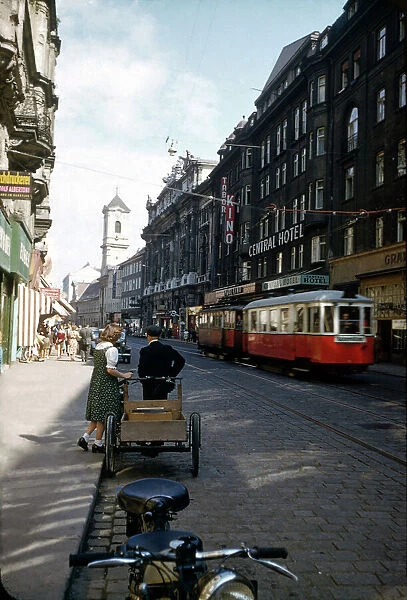

This project situates a trace-based street photography practice within the urban fabric of Vienna. The city is approached not as a historical image or cultural symbol, but as a lived and ongoing temporal field. Each photograph results from a fixed three-minute presence at a single site. Duration is strict. Position is fixed. Movement belongs to the city.
Vienna is often read through its architectural continuity and cultural memory. This project deliberately shifts attention away from landmarks and recognisable narratives. It focuses on residual streets, transitional zones, and ordinary flows. Places where nothing is staged and nothing announces itself as important.
The working method inverts classical street photography. The photographer does not seek decisive moments or emblematic Viennese scenes. Instead, the photographer becomes the static element through which Vienna passes. Pedestrians, trams, reflections, and interruptions act as temporal forces. The photograph is not a depiction of the city. It is an index of shared time spent within it.
Each session begins by accepting a location as a coordinate. A section of Mariahilfer Straße, a tram stop, a residential crossing, or a peripheral passage. Once positioned, no correction follows. The camera is configured minimally and committed to. The apparatus functions as a registering surface tied to the photographer’s body.
During the recording phase, photographs are made without pursuit. The photographer remains physically static while Vienna continues its layered movement. Partial figures, overlaps, occlusions, and empty intervals are preserved. These are not flaws. They are the visible traces of time interfering with space.
The final image of each session marks withdrawal rather than climax. It signals that the three-minute interval has ended. What remains is not a scene but a temporal residue.
Review and interpretation take place away from the street. Images are not evaluated on site. Meaning emerges later, detached from the lived moment. Across the project, all locations are treated equally. Tourist corridors and peripheral streets are given the same duration and attention. Hierarchy is suspended.
This work proposes Vienna not as an image to be captured, but as a city that leaves traces through presence. Street photography here becomes a practice of co-presence. The photograph stands as evidence that time was spent, rather than proof that something happened.